Like most websites, we use cookies to make our site work the way you expect it to, improve your experience on our site, analyze site usage, and assist in our marketing efforts. By choosing "Accept All Cookies", you agree to the storing of all categories of cookies on your device.
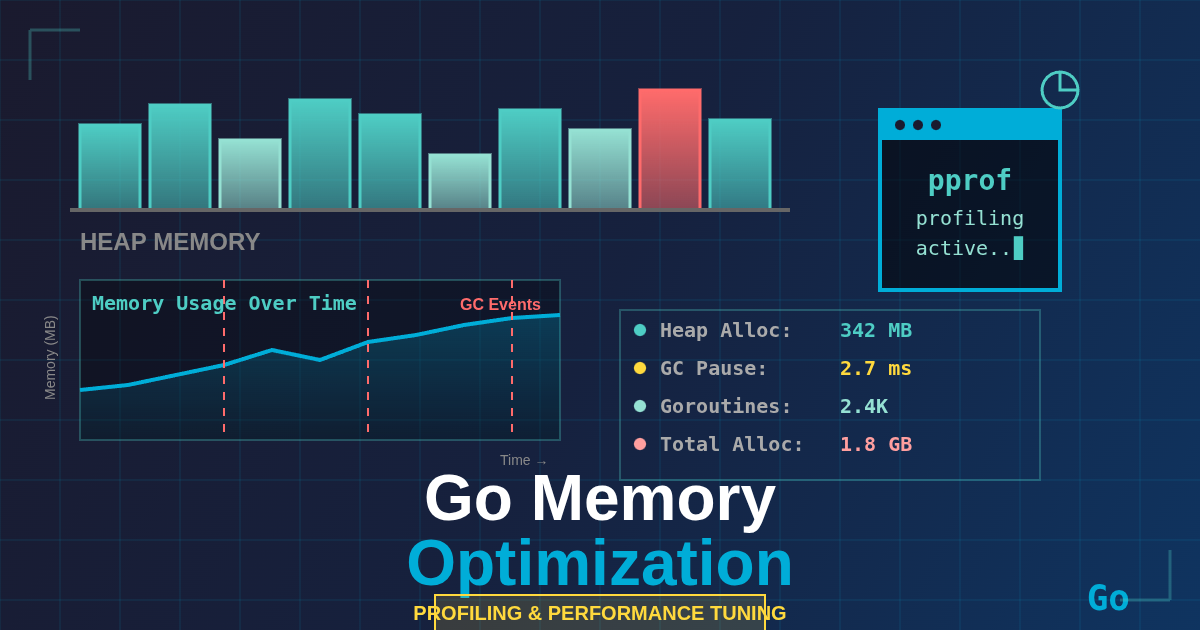
Memory optimization in Go applications is a critical skill that separates good developers from great ones. While Go’s garbage collector handles memory management automatically, understanding how to profile, analyze, and optimize memory usage can dramatically improve your application’s performance, reduce infrastructure costs, and enhance user experience. In production environments where every millisecond and megabyte counts, these skills become invaluable.
Go provides exceptional built-in tooling for memory profiling through the pprof package and runtime statistics.
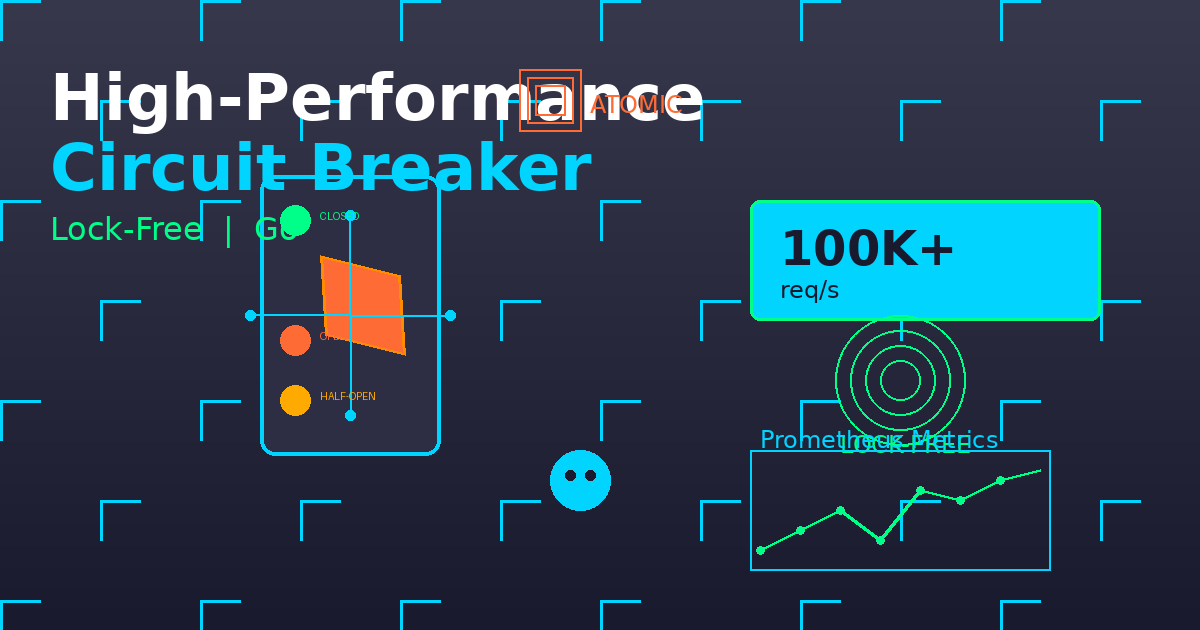
Introduction In distributed systems, cascading failures are one of the most devastating failure modes. When a downstream service becomes slow or unresponsive, upstream services can exhaust their resources waiting for responses, causing a domino effect that brings down entire systems. The 2017 AWS S3 outage, which cascaded across multiple services and lasted nearly four hours, demonstrated how a single service failure can ripple through interconnected systems.
Circuit breakers act as automatic safety switches that prevent cascading failures by detecting when a service is unhealthy and temporarily blocking requests to it.
In today’s regulatory landscape, compliance isn’t just a checkbox—it’s a critical business requirement that can make or break your organization. Whether you’re handling sensitive customer data or protected health information, meeting standards like SOC2 and HIPAA is essential for maintaining trust and avoiding costly penalties. For Go applications, implementing compliance automation can streamline audits, reduce human error, and ensure continuous adherence to regulatory requirements.
This comprehensive guide will walk you through building robust compliance automation systems in Go, covering everything from audit logging to automated policy enforcement.
Container security has become a critical concern as organizations increasingly adopt containerized applications. With the rise of microservices and cloud-native architectures, Go applications running in containers face numerous security challenges, from vulnerable base images to misconfigurations that can expose sensitive data or provide attack vectors.
This comprehensive guide explores how to implement robust security scanning, vulnerability management, and hardening strategies specifically tailored for Go applications. We’ll cover everything from choosing secure base images to implementing runtime security monitoring, ensuring your containerized Go applications maintain the highest security standards throughout their lifecycle.
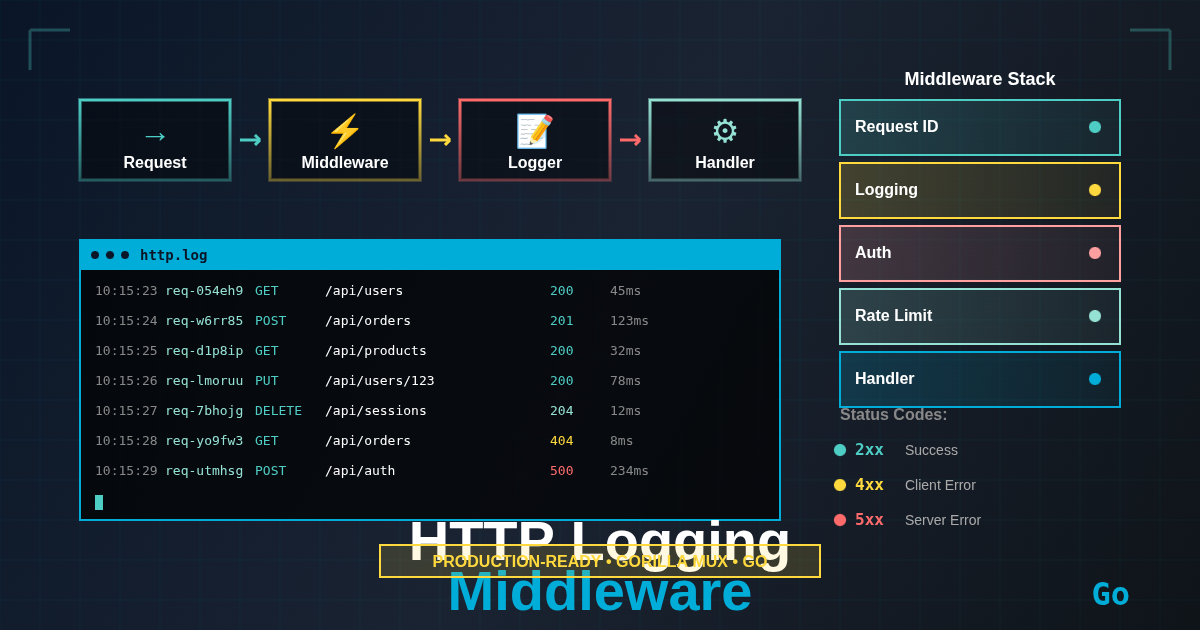
Observability is the cornerstone of modern web applications. When your API starts experiencing issues at 3 AM, comprehensive logging can mean the difference between a quick fix and hours of frustrated debugging. In this guide, we’ll build a production-grade HTTP logging middleware for Gorilla Mux that goes beyond simple request logging to provide actionable insights into your application’s behavior.
Why HTTP Logging Middleware Matters Every HTTP request tells a story. It carries information about who’s accessing your system, what they’re requesting, how long it takes, and whether it succeeds or fails.
Rate limiting is your application’s first line of defense against abuse, whether from malicious actors launching denial-of-service attacks, buggy clients stuck in retry loops, or legitimate users inadvertently overwhelming your system. Without proper rate limiting, a single misbehaving client can bring down your entire service, impacting all users and potentially costing your business significant revenue and reputation.
In this comprehensive guide, we’ll build a production-grade rate limiting middleware for Go HTTP servers that protects your APIs while maintaining performance and flexibility.
A logging middleware is a piece of software that sits between the incoming request and the final handler function in a web application. Its primary purpose is to log information about each request that comes through the application.
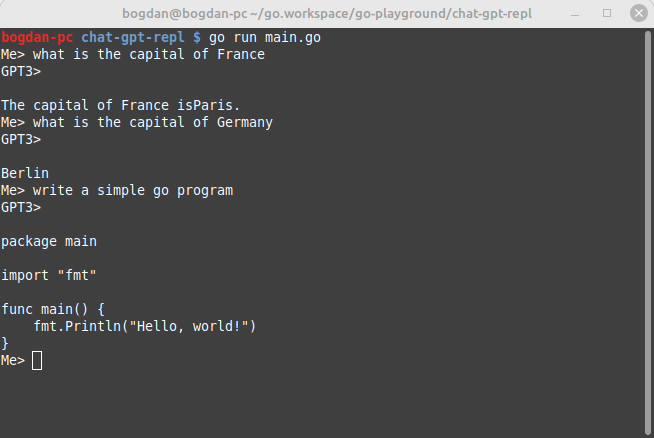
This blog post will discuss how to use the OpenAI Chat API in Golang. For this purpose we will create a simple REPL (Read-Eval-Print-Loop) that will use the GPT-3 API to generate the responses.
No matter if you are creating a simple REST service or a complex one, you will need to handle panics to provide good resiliency and stability. Without panic recovery mechanisms in place, an uncaught panic in your HTTP handler will crash your entire server, leaving your clients without service and no meaningful error response.